Wimbledon
How footwork changes when the ground gives way beneath it
Grass offers less grip than any other surface in regular use, so movement patterns built on hard courts have to be replaced rather than merely adjusted.
Traction sets the movement vocabulary
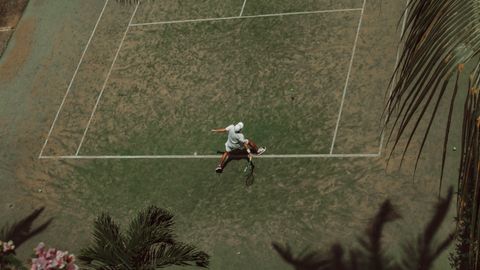
Every change of direction depends on the foot being able to push against the ground, and grass offers considerably less resistance than a hard court. That means the sharp single-step direction change that works on a hard surface is likely to slip, and the player arrives late or falls. The adjustment is to decelerate over more steps, using several smaller ones to shed speed rather than one hard braking stride.
This costs a little time on every direction change, which is one reason grass-court players tend to take smaller and more frequent steps. It also changes how far a player will chase a ball, since the recovery from an all-out sprint is slower when the surface will not grip.
Staying low for the whole point
The low bounce means contact is made close to the ground, and a player who stands upright between shots must lower himself for every one. Repeatedly rising and dropping is slow and tiring, so grass-court movement involves holding a lower posture continuously through the point. That posture also improves stability, since a lower centre of gravity is less likely to slip when the foot loses grip.
The cost is a considerable demand on the legs, which is why the surface produces a distinctive kind of fatigue over a long match. Players who have not prepared for it tend to rise as the match goes on, and the late errors follow from the change in contact height.
Sliding without the clay-court mechanics
Sliding on grass is possible and it works differently from sliding on clay, because the surface does not offer a consistent layer to slide across. A clay slide is controlled and can be initiated deliberately, with the player arriving into the shot on a sliding foot and recovering out of it. On grass the slide is usually a consequence of losing grip rather than a chosen technique, and the recovery from it is much less reliable.
Players who slide well on grass do so by keeping the sliding foot beneath the body rather than extending it out to the side. Extending it, as a clay-court player would, tends to leave the leg in a position from which no push-off is available.
Wear and the changing surface
The court does not stay the same across a match, since the areas that receive the most traffic lose their covering and become bare. Those worn areas behave differently, offering more grip in some conditions and considerably less in others depending on moisture. Players adjust their positioning to account for this, sometimes standing slightly outside a worn patch to keep a reliable push-off foot.
The change is gradual and it is one of the few surface characteristics that a player has to keep re-reading throughout a match. Later in a tournament the effect is more pronounced, because the courts have accumulated far more use than at the start.
What transfers and what does not
The upper-body technique required on grass is broadly the same as elsewhere, with the shortened backswing being the main adjustment. The movement is not the same, and a player arriving from a slow surface will typically spend the first matches misjudging his deceleration. That is the strongest argument for a preparation period on the surface, since the adjustment is motor rather than tactical and cannot be learned from analysis.
Players who skip it often look technically fine and positionally poor, arriving fractionally late to balls they would reach comfortably elsewhere. The gap closes within a few matches, which is why performances on grass tend to improve sharply across a short season.
- Grip is lower, so direction changes must be made over more steps
- The centre of gravity has to stay lower throughout the point
- Sliding is possible but functions differently from clay


