Athletics
What a long jumper is doing in the final strides of the run-up
The approach is not a sprint with a jump at the end. The closing strides are an adjustment mechanism that turns horizontal speed into something the take-off can use.
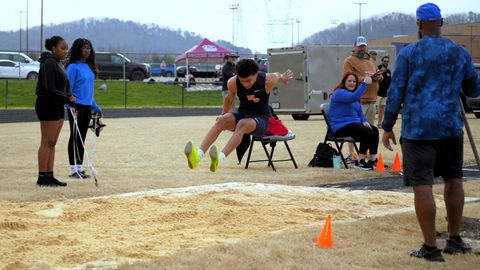
The approach is a controlled accumulation of error
A long jump run-up is measured and marked, yet no athlete produces identical strides twice, so small errors accumulate along its length. By the closing phase those errors amount to a meaningful distance, and the athlete either corrects them or fouls at the board. The correction cannot be made by looking down, because dropping the head changes the posture and destroys the take-off position.
Instead athletes regulate visually against the board itself, adjusting stride length by very small amounts across the final few contacts. This regulation is largely automatic and it is trained by repetition of the full approach rather than by practising the jump in isolation.
Speed is necessary but not sufficient
Horizontal velocity at take-off is the largest single contributor to the distance achieved, which is why sprinters are often good jumpers. But velocity alone produces a flat trajectory, and a jump with no vertical component lands early regardless of how fast the athlete was travelling. The take-off has to convert some horizontal speed into vertical without losing much of the rest, and that conversion is the technical heart of the event.
Athletes who arrive too fast to manage the conversion effectively waste the speed they generated during the approach. This is why the fastest approach an athlete can run is rarely the fastest approach he should run.
Lowering and raising the centre of mass
In the penultimate stride the athlete lowers his hips, which lengthens the path over which vertical force can be applied at take-off. That stride is therefore slightly longer and flatter, and the final stride is shorter and quicker to bring the take-off foot beneath the body. Getting the sequence the wrong way round is a common fault, and it leaves the athlete rising into the board with no room to drive upwards.
The lowering also has to be produced by the legs rather than by leaning back, since leaning shifts the mass behind the foot and applies a braking force. Athletes who brake at take-off convert their approach speed into noise, and the jump feels powerful while travelling nowhere.
The take-off foot and the ground contact
The contact at the board is extremely brief, which means the force has to be applied through a leg that is already stiffened before it lands. A leg that collapses on contact absorbs the energy the approach generated and returns very little of it as vertical velocity. The foot is planted close to flat rather than on the heel or the toe, since either extreme reduces the surface through which force can be transmitted.
The free leg and the arms drive upward at the same moment, adding to the vertical impulse without requiring anything from the take-off leg. The coordination of those three actions inside a very short contact is what separates jumpers with similar approach speeds.
What happens in the air is limited
Once the athlete has left the ground the trajectory of his centre of mass is fixed and nothing done in flight can change where it lands. Flight techniques therefore serve a different purpose, which is to control rotation so that the legs can be extended at landing rather than dragged. A jumper who rotates forward in the air is forced to put his feet down early, losing distance that the take-off had already earned.
The hitch-kick and the hang are two ways of managing that rotation, and neither adds height or speed to the jump itself. Understanding this changes how the event is watched, since the dramatic part in the air is essentially damage control for the part on the ground.
- The last strides adjust for accumulated error without losing speed
- Lowering the hips before take-off is what allows vertical drive
- Visual regulation replaces counting in the final phase