Football
Why a midfielder's first touch decides the next three passes
The direction a receiving player takes the ball in determines which options remain available, so the touch is a passing decision made before the pass.
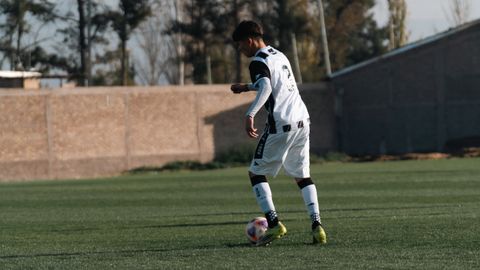
The touch is a decision about geometry
When a midfielder receives with his back to the opposition goal, the direction of his first touch determines which half of the pitch remains reachable. A touch taken across the body opens a passing angle to one side while eliminating the other, and the elimination is permanent for the next few seconds. That is why coaches speak about receiving on the half-turn: the aim is to arrive in a body position from which more than one forward option still exists.
The alternative, taking the ball straight into the feet with square shoulders, is comfortable and almost always reduces the player to a backwards or sideways pass. The mistake is rarely the pass that follows, since by then the geometry has already been decided and the player is choosing among what remains.
Scanning determines what the touch can be
A player cannot take a touch into space he does not know is there, so the quality of the first touch depends on information gathered before the ball arrives. The habit is a series of quick glances over each shoulder in the seconds while the ball is travelling, building a rough map of pressure and space. What matters is not a single look but the frequency of looking, because the picture decays quickly as opponents move and the map has to be refreshed.
Players who scan late take a touch based on where the defender was rather than where he is, which is how a player gets closed down by someone he never saw. The most visible symptom of poor scanning is a midfielder who consistently receives and then immediately turns back the way the ball came.
Using the defender's momentum
The pressing defender behind a receiving midfielder is committed to a direction before the ball arrives, and that commitment is exploitable. A touch that goes with the defender's momentum takes the ball into the space he has just vacated, and no amount of recovery speed fully undoes that. This is why the best receivers appear to let the defender arrive before moving, rather than trying to escape early while the defender still has options.
The risk is obvious, since a mistimed touch under contact gives the ball away in the most dangerous area of the pitch. The judgement is a matter of feel for the defender's distance and speed, and it improves through repetition under genuine pressure rather than in isolated drills.
Receiving on the back foot
Taking the ball with the foot furthest from the opponent adds a step's worth of distance between the defender and the ball at the moment of control. It also naturally rotates the body, so the player finishes the touch facing more of the pitch than he was facing when the ball arrived. The technique is harder than it sounds, because it requires the player to open his hips before the ball reaches him rather than as it arrives.
Players who receive on the near foot are usually reacting to the ball's flight rather than having pre-positioned their body for it. Over ninety minutes the difference shows up as a midfielder who is repeatedly dispossessed in areas where he appeared to have time.
Why the third pass is the one that matters
A first touch that opens the body allows a forward pass, and a forward pass into a player who is also open allows the move to continue rather than restart. Sequences that break down usually do so because one receiving player closed his body, forcing a recycle that gives the defence time to reset its shape. That is why possession numbers can look identical for two teams whose attacks feel entirely different in character.
The team that keeps opening its body advances the ball in stages; the team that keeps closing it circulates without ever changing the defensive picture. The mechanism is entirely contained in the first touch of each receiver, several passes before anything that resembles a chance appears.
- A touch that opens the body preserves options; a touch that closes it removes them
- Scanning before the ball arrives is what makes the correct touch possible
- The defender is committed by the touch, not by the pass that follows


